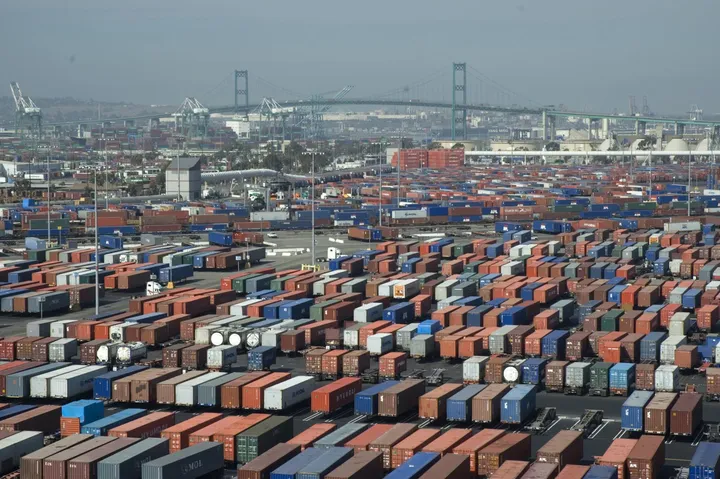
A trade deficit means a country’s imports exceed its exports over the period measured. It does not, by itself, mean the economy is shrinking. In the GDP accounts, exports add to measured domestic production and imports are subtracted, but GDP also reflects consumer spending, investment and government spending. A business buying imported equipment can widen the trade gap while domestic investment rises. To assess growth, the full set of components and the period’s overall output matter, not the sign of net exports alone.
What the trade balance counts
The Bureau of Economic Analysis defines the U.S. trade balance as exports—sales to residents of other countries—minus imports, or U.S. purchases from abroad. The monthly goods-and-services measure can be a deficit or surplus. In August 2026, the deficit was $105.6 billion, up from a revised $92.8 billion in July as imports increased more than exports. The next release was scheduled for November 4. Bureau of Economic Analysis
That monthly trade figure is not itself a measure of total U.S. production. GDP measures the value of final goods and services produced in the United States. Trade data and GDP accounts are related, but they answer different questions: one compares cross-border sales and purchases, while the other measures domestic output and its uses. Bureau of Economic Analysis Bureau of Economic Analysis
Imports are subtracted for a reason
The GDP accounting identity includes consumption, investment, government spending and net exports, defined as exports minus imports. Imports are subtracted because spending on an imported product may already appear in consumption, investment or government spending, even though that product was not produced domestically. The subtraction keeps the measure focused on production within the country. Bureau of Economic Analysis Bureau of Economic Analysis
Consider a fictional domestic business that imports a machine for its factory. The purchase may raise measured investment, while the machine’s imported value is subtracted in the net-export component. If the business and households also increase spending on domestically produced goods and services, total GDP can still rise. This example illustrates accounting, not a claim about how any particular import changes jobs or productivity.
The overall growth rate includes other components
The advance estimate for the third quarter of 2026 reported real GDP growth at a 3.4 percent annual rate. BEA said increases in investment, consumer spending and government spending were partly offset by a decrease in exports; imports also increased and subtract in the GDP calculation. The reported annualized rate is not quarter-on-quarter growth of 3.4 percent. It was an advance estimate subject to revision. Bureau of Economic Analysis
This is a direct example of why the trade balance alone cannot determine the direction of GDP. The economy’s other components can outweigh a negative contribution from net exports. The figures do not mean imports caused the growth rate, nor that every sector or household experienced growth. They show how the measured components contributed to an aggregate result for a particular quarter. Bureau of Economic Analysis
Use the right measure for the question
A trade deficit can rise because imports increase more than exports, as BEA reported for August. That fact alone says neither that overall output fell nor why import demand changed. A larger import bill might accompany investment in equipment, consumer purchases or other activity; the monthly trade balance does not by itself distinguish those motives or show their economic consequences. Bureau of Economic Analysis
For a growth question, use real GDP and examine its components; for the cross-border balance, use exports minus imports. GDP estimates are released in advance, second and third rounds as more information becomes available, and quarterly percentage changes are generally reported at annual rates. Keeping the definitions and timing straight avoids turning one trade statistic into a verdict on the whole economy. Bureau of Economic Analysis
Sources & further reading
- U.S. international trade in goods and services ↗Bureau of Economic Analysis
- Third-quarter 2026 GDP advance estimate ↗Bureau of Economic Analysis
- Gross domestic product explained ↗Bureau of Economic Analysis